New Jersey's 2026 ABC Test: Why Rideshare Drivers Are Likely Employees
On May 5, 2026, the New Jersey Department of Labor and Workforce Development adopted N.J.A.C. 12:11, a new chapter of regulations explaining how the State applies its ABC test for employee classification. The rules are scheduled to become operative on October 1, 2026.
The ABC test itself is not new. It has existed in New Jersey statutes and court decisions for decades. What changed in 2026 is that the Department formally put much of that law and agency guidance into one regulatory chapter. The Department described the rules as a way to clarify the statutory test, protect workers, and give businesses a clearer standard.
For New Jersey rideshare drivers, that matters. In our opinion, many drivers have a strong argument that they are employees, not independent contractors. Prong B is a central reason why. A rideshare company sells transportation to riders, and drivers perform the transportation. The final rule also says a company's usual course of business can include activities it regularly performs to generate revenue or provide services, and that a place of business is not limited to a corporate office.
New Jersey law evaluates the facts of the working relationship, but the burden stays where it belongs: on the company. In our opinion, many New Jersey rideshare drivers have a strong case that the rideshare companies cannot prove all three prongs and cannot lawfully treat them as independent contractors.
The short answer for New Jersey rideshare drivers
- New Jersey starts with the presumption that a person who performs services for pay is an employee.
- The rideshare company must prove A, B, and C to establish independent-contractor status.
- If the company fails even one prong, the worker is treated as an employee under the laws that use this test.
- Prong B asks whether driving is outside the company's usual course of business or outside all its places of business.
- The Department proposed an unusually direct rideshare example saying a transportation-network driver's work was likely not outside the company's usual course of business.
- The Department removed that example from the final rule text after public comments, but said the "root principles" the example illustrated remain in the final rule.
- Employee status can affect minimum wage, compensable waiting time, deductions, required testing costs, earned sick leave, unemployment contributions, and other employment protections.
The Department's May 5, 2026 announcement and the full notice of adoption are the primary sources for the new rules.
What New Jersey's ABC test requires
New Jersey does not let a company decide worker status just by placing the words "independent contractor" in an agreement. The legal question turns on the substance of the relationship.
Once a worker has performed services for pay, the putative employer must establish all three parts of the ABC test:
- A. Freedom from control: The worker has been and will continue to be free from the company's control or direction, both under the contract and in actual practice.
- B. Outside the business: The service is either outside the company's usual course of business, or it is performed outside all the company's places of business.
- C. Independently established business: The worker is customarily engaged in an independently established trade, occupation, profession, or business.
The adoption notice quotes the New Jersey Supreme Court's rule in plain terms: the company must satisfy all three criteria, and failure on any one results in employee classification.
That burden matters. A driver does not have to lose A, B, and C. The driver can be an employee if the company fails A, B, or C.
Prong A: How much control does the rideshare company have?
Prong A asks about control in the contract and control in real life. The 2026 regulations say a company does not need to control every part of the work for a person to be an employee.
The factors include whether the company:
- Requires set hours or jobs
- Controls the details and means of the work
- Requires the services to be performed personally
- Sets the worker's rate of pay
- Places the worker on call, on standby, or otherwise requires availability at set times
- Limits work for other parties, including by geography or clientele
- Provides training
Drivers often have real flexibility. They may decide when to sign on, when to sign off, and which parts of New Jersey to work in. That evidence belongs in the analysis.
But flexibility is not the whole test. A rideshare company may set or heavily influence fares, control access to riders, impose vehicle and conduct rules, track location and performance, use ratings or acceptance data, change compensation formulas, and suspend or terminate access to the platform. A driver's ability to choose a shift is only one factor and, in our opinion, does not overcome this extensive evidence of control.
The actual platform rules and the driver's experience often show meaningful control under Prong A. Prong B presents an even more basic problem for the rideshare companies.
Prong B: Is transporting riders outside a rideshare company's business?
Prong B gives the company two possible routes. It must prove either:
- The driver's services are outside the company's usual course of business, or
- The driver's services are performed outside all the company's places of business.
The final regulation states that a company's usual course of business may include activities it regularly engages in to "generate revenue" or to "develop, produce, sell, market, or provide goods or services." It also says an entity may have more than one usual course of business.
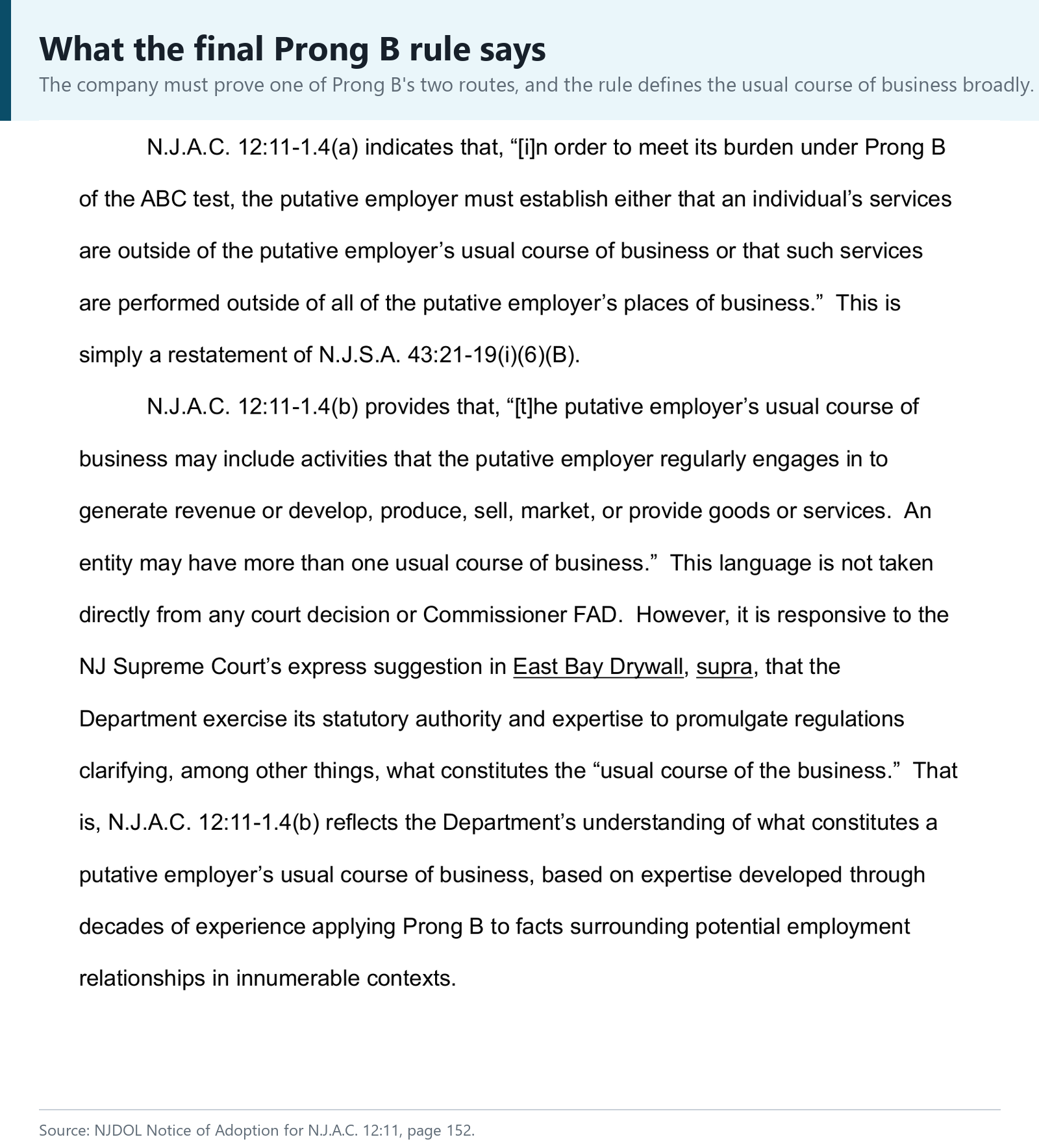
This language is important because rideshare companies commonly describe themselves as technology marketplaces that connect riders and drivers. The final rule directs attention to what the enterprise regularly does to generate revenue and provide its services. It also rejects the idea that an entity must have only one usual course of business.
The practical questions are straightforward:
- What service does the rider believe they are purchasing?
- What activity generates the company's revenue?
- Could the company complete a paid ride without a driver transporting the rider?
- Does the company market access to software alone, or does it market reliable transportation from one location to another?
In our opinion, the answer is difficult for the rideshare companies. A rider opens the app to obtain a ride. The company earns money when transportation occurs. The driver performs the service that makes the transaction possible.
The Department's rideshare example, and the context that must accompany it
The Department originally proposed a rideshare-specific example under Prong B. It said:
"The services performed by the driver are likely not outside of the transportation network company's usual course of business."
That is unusually direct language from the agency responsible for enforcing New Jersey's wage laws. But accuracy requires the next part of the story.
After receiving public comments, the Department removed the specific examples from the final rule text, including the rideshare example. The Department explained that some commenters believed examples would create confusion in a fact-sensitive test. The Department did not say the underlying Prong B analysis was wrong. Instead, it stated that the "root principles" the examples were intended to illustrate remain in N.J.A.C. 12:11-1.4.
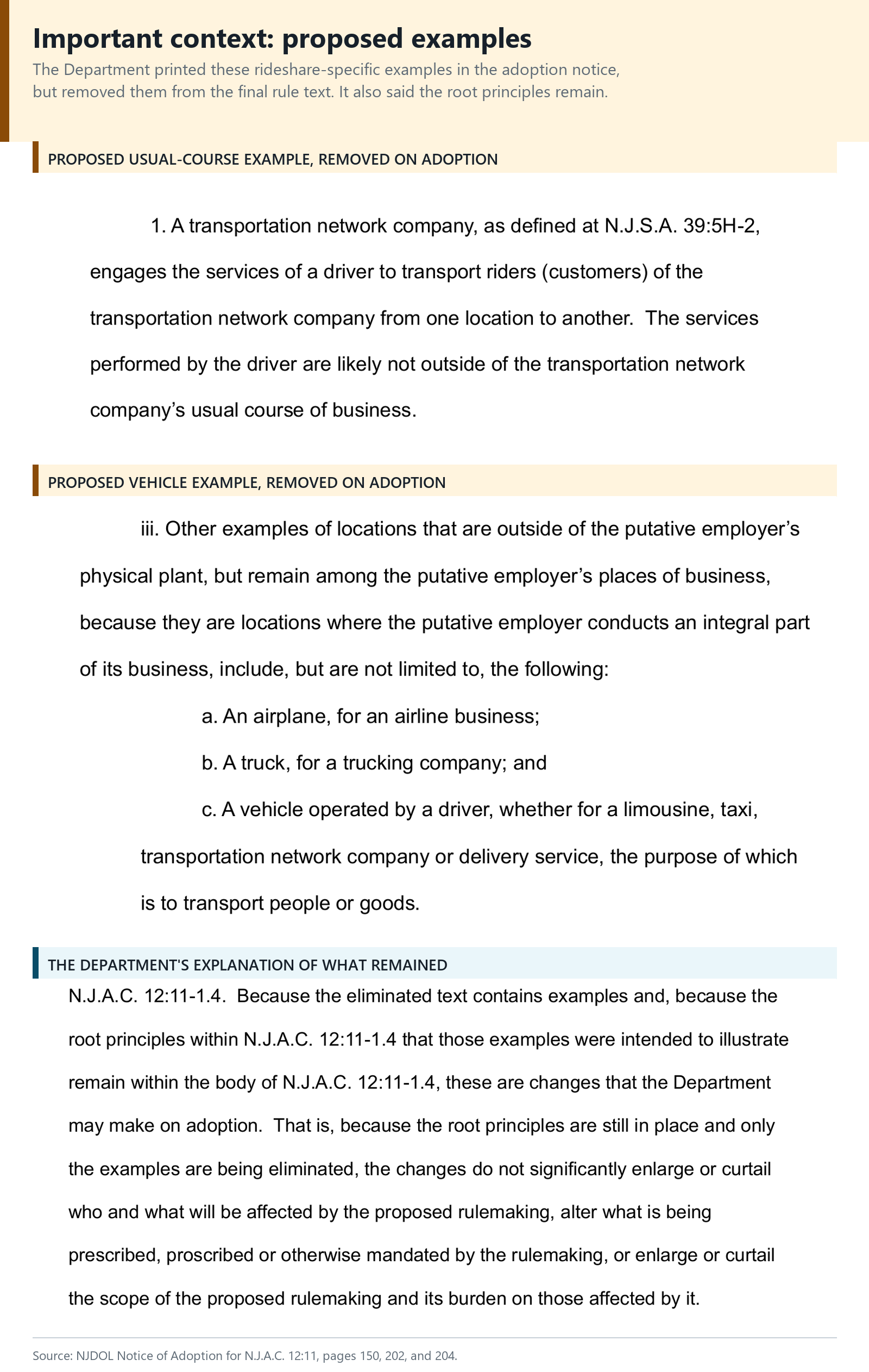
The strongest and most accurate takeaway is this: the Department publicly applied its Prong B reasoning to rideshare work, then removed the example while expressly retaining the principles behind it. Those retained principles strongly support employee classification for drivers who perform the transportation service the rideshare companies sell.
That history gives drivers powerful evidence of how the Department understands Prong B. The rideshare companies cannot fairly dismiss this analysis as a theory invented by drivers' lawyers.
Why the driver's vehicle supports a failure of Prong B
The second route under Prong B asks whether the service is performed outside all the company's places of business.
The final regulation says "places of business" includes locations where the enterprise has a physical plant or conducts an integral part of its business.
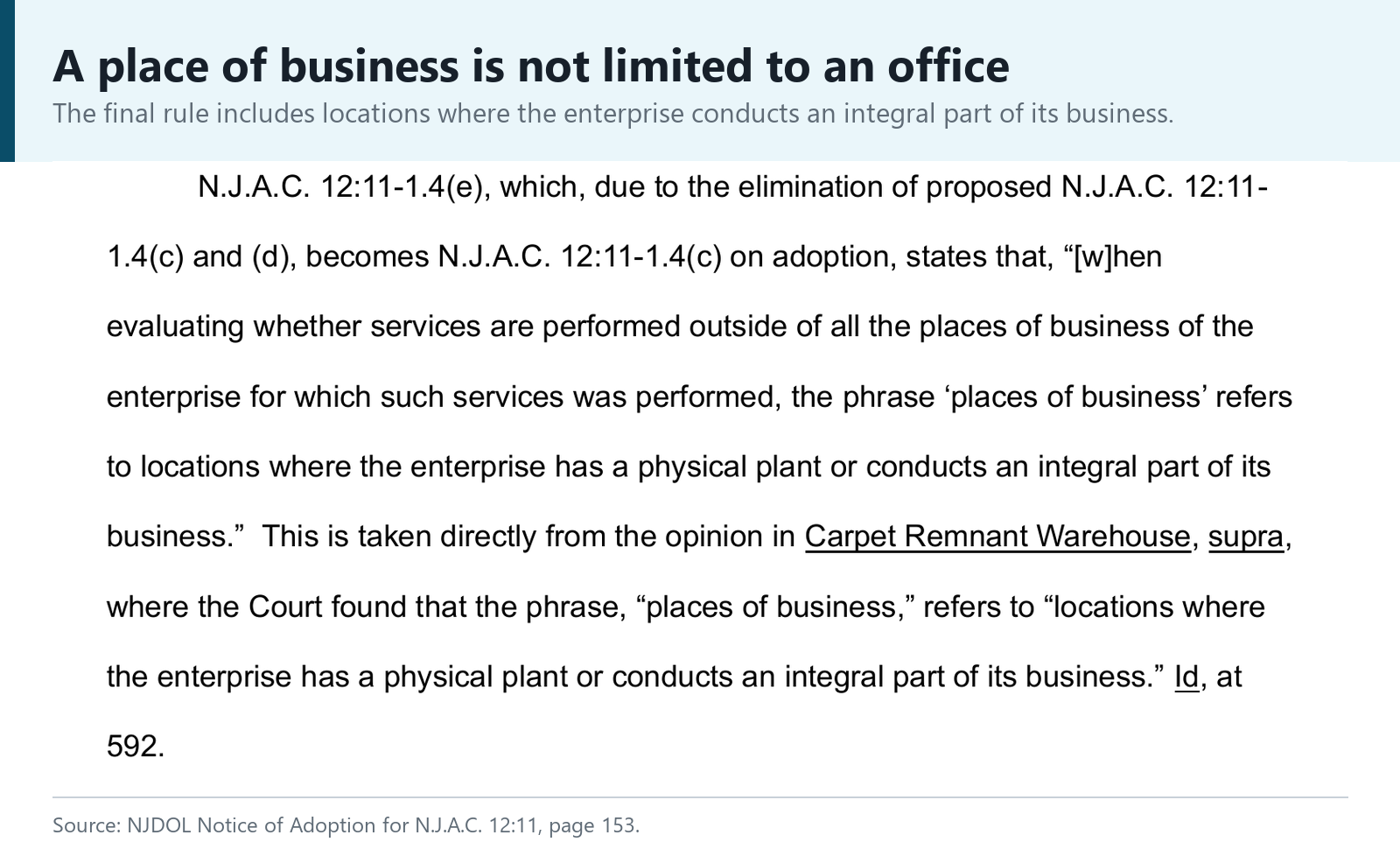
That definition is broader than a headquarters, office, or storefront. The legal focus is also on where an integral part of the enterprise's business occurs.
The Department's proposal made the transportation issue explicit. One proposed example identified a vehicle operated by a driver for a taxi, transportation-network company, or delivery service as a place where an integral part of the business occurs. Although the Department removed the specific vehicle example after public comments, it retained the broader "integral part" principle in the final rule.
The final rule does retain the broader "integral part" principle. In our opinion, that principle supports a serious argument that the vehicle is a place where an integral part of a rideshare company's transportation business is conducted. The ride does not occur in the company's office. It occurs in the driver's car.
That is a major point. The company should not be able to prove Prong B merely by saying the driver owns the car and works away from corporate headquarters. Ownership of the physical vehicle and the legal meaning of "place of business" are different questions. The vehicle is where the company's core transportation service is performed.
Prong C: Is the driver truly running an independent transportation business?
Prong C asks whether the driver is customarily engaged in an independently established business that exists apart from the relationship with the rideshare company.
The final rules direct attention to factors such as:
- The duration, strength, and viability of the worker's business apart from the company
- The number of customers and the volume of business from each
- The share of income received from the company compared with income from others in the same industry
- The number of employees in the worker's business
- The worker's investment in tools, equipment, vehicles, buildings, and other resources
- Whether the worker sets their own rate of pay
- Whether the worker advertises, maintains a visible business location, and is available in the market
The regulations also make several points that are especially important for gig drivers. Having multiple employers does not itself prove an independently established business. Working full time or part time for someone else is not enough. A business registration, limited liability company, or insurance policy is relevant, but none is sufficient by itself.
For a rideshare driver, the questions may include:
- Can the driver set the price charged to the rider?
- Does the driver advertise an independent transportation business?
- Does the driver have customers who belong to the driver's business, or only riders supplied by an app?
- Can the driver's business continue if the rideshare company removes platform access?
- Does the driver build goodwill for an independent company, or for the platform?
A genuine independent transportation business ordinarily sets its own prices, advertises, maintains its own customers, builds its own goodwill, and can continue operating without access to any one app. Most app-based rideshare drivers do not operate that kind of independent enterprise. Merely using more than one app, owning a car, or receiving a Form 1099 does not satisfy Prong C.
Why employee status changes the financial picture
Classification is not an abstract label. It determines who carries the costs and risks of the business, what time must be recorded, what deductions may be taken, and which worker protections apply.
Rideshare drivers currently shoulder expenses that make the service possible, including:
- Buying or leasing the vehicle
- Fuel and charging
- Maintenance, repairs, tires, and oil
- Depreciation and accelerated wear
- Insurance, registration, inspections, tolls, and cleaning
- A phone and data plan
- Certain fees, checks, tests, or other requirements tied to gaining or keeping platform access
The rideshare companies benefit from those expenditures. The driver pays them.
In our opinion, drivers can likely use the IRS mileage rate to estimate their vehicle expenses in wage, misclassification, and arbitration proceedings and to support a reasonable calculation of damages. The rate supplies a recognized, administrable measure of the costs shifted from the rideshare company to the driver. Drivers may also prove that their actual expenses are higher. Classification opens the door to wage, deduction, expense, and recordkeeping rules that the contractor label is used to avoid.
The 76-cent mileage benchmark shows how quickly gross pay disappears
Effective July 1, 2026, the IRS business mileage rate is 76 cents per mile. The rate was 72.5 cents per mile for the first half of 2026. The IRS explains that the business rate is based on an annual study of the fixed and variable costs of operating a vehicle, and it issued the midyear increase after fuel prices rose.
The IRS rate is an official federal tax and reimbursement benchmark based on a study of the fixed and variable costs of operating a vehicle. In our opinion, that makes it persuasive evidence for estimating a driver's expenses and likely damages. A driver's real costs may be even higher, particularly when the driver uses a larger vehicle with higher fuel, tire, repair, insurance, and depreciation costs.
Rideshare work can also create unusually high wear and tear. Drivers accumulate miles quickly, spend long periods idling, make repeated stops and starts, drive to pickups without a passenger, and operate in dense traffic. Those conditions can accelerate depreciation and the need for tires, brakes, oil, repairs, and major maintenance.
Consider a driver who grosses $20 during an hour and drives 20 business miles in that time:
- Gross receipts: $20.00
- 20 miles at $0.76 per mile: $15.20
- Amount left after that mileage benchmark: $4.80
That $4.80 is before considering self-employment tax or other costs that may not be fully captured in the example. Economically, a headline rate of $20 per hour can be far below New Jersey's minimum wage after the driver supplies the vehicle.
In a legal proceeding, mileage records, expense receipts, compensable hours, gross wages, and deductions can be used together to establish how far a driver's real pay fell below the lawful minimum. The example shows why "I made $20 an hour" does not end the analysis and why the expense claim can produce substantial damages.
The IRS announcement of the July 2026 mileage increase provides the current 76-cent rate.
New Jersey minimum wage is $15.92 per hour in 2026
As of January 1, 2026, New Jersey's minimum wage is $15.92 per hour for most employees, according to the New Jersey Department of Labor's minimum-wage guidance.
For a worker paid by the trip, piece, commission, or another non-hourly method, the law still asks whether wages satisfy the applicable minimum for the compensable hours worked. A company's marketing number for "active" driving time does not define all legal work time.
The State's hours-worked rules say employees must be paid for all hours worked, including time they are required to be at the place of work or on duty. They also recognize that waiting time can count when on-call conditions are so restrictive that the worker cannot effectively use the time for personal purposes.
Drivers are likely entitled to compensation for waiting periods when platform restrictions prevent them from using the time effectively for personal purposes. Evidence can include whether the driver must remain in a location, is subject to response or pickup rules, receives frequent requests, or is otherwise restricted. Employee status prevents the platform from simply erasing that working time by labeling it inactive.
The relevant provisions are collected in the New Jersey wage-and-hour laws and regulations, including N.J.A.C. 12:56-5.1, 5.2, and 5.6.
Deductions and required testing costs may be unlawful for employees
New Jersey tightly regulates deductions from employee wages. A company generally may not withhold or divert wages unless the deduction is required by law or falls within a category the law permits.
That matters when a rideshare company takes money from a driver's earnings for access fees, platform charges, equipment, insurance-related items, or other expenses that primarily benefit the company. The name placed on the charge does not decide whether it is lawful. The actual purpose, authorization, and effect of the deduction matter.
Testing expenses can matter too. New Jersey's official employer guidance says that, except for a specified security-guard situation, an employer cannot require a worker to pay for drug testing, medical examinations, visual examinations, and similar pre-employment testing, or deduct those costs from pay. Driver-paid tests and access requirements should be included when calculating the costs shifted onto the worker.
The Department's payroll-deduction guidance provides examples of deductions and testing costs that employers may not shift to employees.
Employee status can mean earned sick leave, not automatic vacation pay
New Jersey requires most employees to receive earned sick leave. Covered employees generally accrue one hour of paid sick leave for every 30 hours worked, up to 40 hours per benefit year. An employer can instead provide the 40 hours up front.
This is important for rideshare drivers who currently receive no paid time when they are sick, caring for a family member, attending certain school events, or addressing qualifying domestic or sexual violence needs.
The accurate phrase is earned sick leave, not a promise of paid vacation. New Jersey generally does not require employers to offer vacation or holiday pay. If a company does offer those benefits, other rules may govern the policy. The State's earned sick leave guidance explains the accrual and permitted uses.
Depending on the law and the worker's circumstances, employee classification may also affect unemployment coverage, temporary disability and family leave contributions, workers' compensation, wage statements, payroll records, and other protections. Each benefit has its own eligibility rules and exceptions.
What evidence should a New Jersey rideshare driver preserve?
Classification and wage claims are built on records. Drivers should consider preserving:
- Weekly and monthly earnings statements
- Trip histories and mileage logs
- Screenshots of app-on, waiting, pickup, and passenger time
- Records of unpaid driving to pickups or between trips
- Receipts for fuel, charging, repairs, tires, insurance, tolls, cleaning, phones, and data
- Notices about fares, pay formulas, bonuses, ratings, acceptance, cancellation, and deactivation
- Agreements and every later revision the company sends
- Records of fees, deductions, tests, checks, inspections, or required purchases
- Communications with driver support
Do not assume the platform will preserve every version of every record. Contemporaneous screenshots and exports can help show what the company required and what the work actually cost.
Frequently asked questions about New Jersey rideshare employee status
How strongly do the 2026 rules support employee status for rideshare drivers?
Very strongly, in our opinion. The Department proposed a rideshare-specific Prong B example stating that a driver's transportation services were likely not outside the company's usual course of business. It removed the example from the final rule text after public comments, while expressly stating that the root principles behind the example remain. Those principles strongly support employee classification.
When do the 2026 New Jersey ABC test rules become operative?
The Department adopted and filed the rules on May 5, 2026. Its official announcement states that N.J.A.C. 12:11 will be operative on October 1, 2026.
Why is Prong B so important for rideshare drivers?
Prong B asks whether transporting riders is outside the rideshare company's usual course of business or outside all its places of business. The final rule looks at revenue-generating and service-providing activities, allows an entity to have more than one usual course of business, and includes locations where an integral part of the business occurs.
Does a driver's car count as the rideshare company's place of business?
The final regulation does not specifically name a rideshare vehicle. It says a place of business includes a location where the enterprise conducts an integral part of its business. The Department proposed a specific vehicle example but removed it on adoption. In our opinion, the final integral-part principle supports a strong argument that transportation in the driver's vehicle belongs in the Prong B analysis.
Does working for more than one app make a driver an independent contractor?
The 2026 regulations make clear that having multiple employers does not equal having an independently established business. Prong C looks at the driver's actual business, customers, pricing, advertising, independence, investment, and ability to continue apart from a particular company.
Is every online or waiting minute compensable?
Waiting time is likely compensable when platform restrictions prevent a driver from using the time effectively for personal purposes. The platform's labels do not control the legal answer. Location requirements, response rules, pickup obligations, frequency of requests, and the driver's practical freedom during the waiting period are important evidence.
How can drivers use the 76-cent IRS mileage rate?
The IRS rate likely provides a persuasive and administrable estimate of vehicle expenses and damages. A driver's actual costs may be higher, especially for a larger vehicle or a vehicle subjected to unusually heavy rideshare mileage and wear. Mileage logs, maintenance records, receipts, and vehicle information can strengthen that calculation.
The bottom line for New Jersey rideshare drivers
New Jersey's 2026 regulations formally codify the framework the Department will use, put the burden on the rideshare company, and sharpen the meaning of Prong B. In our opinion, those rules give many New Jersey rideshare drivers a strong case for employee classification.
The final rule asks what the company regularly does to generate revenue and provide services. It says a business may have more than one usual course. It defines places of business to include locations where an integral part of the enterprise occurs. Applied to paid passenger transportation, those principles create a serious employee-classification problem for the rideshare companies.
Our firm represents thousands of rideshare drivers throughout New Jersey. We are examining how N.J.A.C. 12:11 affects misclassification, minimum wage, waiting time, deductions, vehicle expenses, and earned sick leave claims. A contractor label printed in an app agreement cannot override New Jersey's employee-protection laws.
You can also read our detailed discussion of what New Jersey rideshare drivers may be owed if they are employees, our guide to New Jersey rideshare wage theft, or visit gigdriver.lawyer to learn more.
Drove in New Jersey? Find out what you may be owed.
Free case review for NJ rideshare and delivery drivers. You pay nothing unless we recover for you.
Check if I qualifyAttorney Advertising. Swartz Swidler, LLC. General information, not legal advice. Results may vary depending on your particular facts and legal circumstances.